







The Citizen Bulletin is a hyperlocal digital news outlet dedicated to accountability journalism, solutions-focused reporting, and data-driven storytelling for the great region of Matabeleland. Join our WhatsApp Channel here.
HWANGE (The Citizen Bulletin) — Makwika village, Hwange district, is no stranger to the sound of commotion at 8p.m. Residents are often forced to scare off invading herds of elephants, a growing and distressing occurrence that has become all too common.
“The elephants were reported searching for food (mangoes) and water when one mercilessly attacked her. She later succumbed to injuries, drawing ire from residents arguing not enough was being done to deal with the elephant problem,” says a local resident, reflecting on the recent tragic incident that claimed the life of Lydia Dube (30), a mother of two doing night guard duty protecting a broken-down crane.
The industrial sounds of heavy machinery tearing into the earth can be heard in the distance, billowing smoke into the sky as mining operations, primarily run by Chinese-owned companies, continue their coal extraction activities near the boundaries of Hwange National Park.
“While discouraging coal mining and disturbing natural habitats, authorities should invest in parks water infrastructure,” says Daniel Sithole, the director of the Green Shango Trust, a local environmental organization.
The consequences of mining activities reach beyond immediate environmental degradation, impacting animal migratory routes, increasing habitat fragmentation, and leading to heightened human-wildlife conflicts.
“Residents now live in fear of elephant attacks as their presence notably increases in Lusumbami, Makwika, and Madumabisa, largely due to mining disturbing wildlife habitats and causing water and food shortages in the park”
Fidelis Chima, Greater Hwange Residents Trust coordinator, emphasizing the urgent need for government intervention
As the 2023/24 El Niño phenomenon is expected to bring drought to Zimbabwe, elephants are likely to venture into agricultural and human settlement areas in search of sustenance, increasing the potential for conflict with humans.
Zimbabwe has witnessed a significant increase in human-wildlife conflict deaths, particularly in regions such as Kariba, Hwange, and Binga, where elephant, buffalo, and crocodile attacks are most prevalent.
“Zimbabwe has the highest human-wildlife conflict deaths in the SADC region,” notes Tinashe Farawo, a spokesperson for the Zimbabwe Parks and Wildlife Management Authority. “The authority is monitoring ground rangers managing problem animals, but questions remain about the boundaries of wildlife areas relative to the disturbance caused by mining activities.”
The escalating human-wildlife conflicts in Hwange are not isolated events but are part of a broader pattern linked to the expansion of coal mining activities. Mining activities, including exploration, construction, operation, and maintenance, have led to extensive land-use changes and various negative impacts on the environment such as deforestation, erosion, soil contamination, and alterations to local ecosystems.
Research shows that the infrastructure developed to support mining operations, like roads, ports, railway tracks, and power lines, can disrupt animal migratory routes and contribute to habitat fragmentation. This disruption has direct consequences, resulting in increased human-wildlife conflict and adding to the broader challenges posed by climate change.
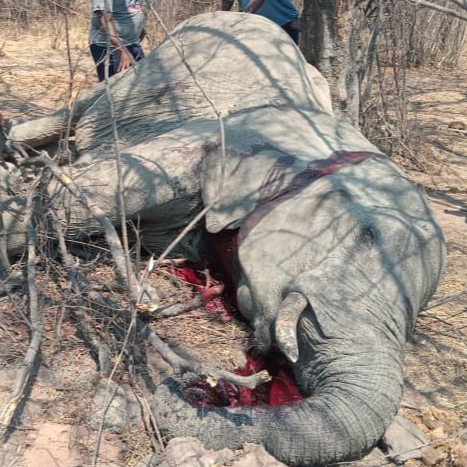
As mining activities encroach upon vital wildlife corridors and watering holes, historical migratory routes are being cut off, compelling animals to search for food and water in areas inhabited by humans. Consequently, this has led to a rise in conflicts, with wild animals, especially elephants, breaking down fences and raiding crops, causing deadly consequences for both humans and wildlife.